Management of public-private partnership projects and their risks in the healthcare system of the Kyrgyz Republic
ORIGINAL RESEARCH ARTICLE
Management of public-private partnership projects and their risks in the healthcare system of the Kyrgyz Republic
Article Summary
- DOI: 10.24969/hvt.2026.639
- CARDIOVASCULAR DISEASES
- Published: 01/04/2026
- Received: 12/10/2025
- Revised: 20/03/2026
- Accepted: 20/03/2026
- Views: 818
- Downloads: 670
- Keywords: Hemodialysis, public-private partnership, quality, medical care, healthcare organization, chronic kidney disease, risks
Address for Correspondence: Bolot A. Abilov, International University of Medicine and Science (IUSM), Bishkek, Kyrgyzstan
E-mail: bolotabilov75@gmail.com
ORCID: Mederbek A. Ismailov – 0009-0009-9216-7943; Bolot A. Abilov - 0000-0002-1079-7848
Mederbek A. Ismailov1, Bolot A. Abilov2*
1The Center for the Development of Healthcare and Medical Technologies at Ministry of Health of the Kyrgyz Republic, Bishkek, Kyrgyz Republic
2International University of Medicine and Science (IUSM), Bishkek, Kyrgyz Republic
Abstract
Objective: This study is devoted to the practice of implementing a public-private partnership (PPP) project in the healthcare system with an emphasis on the organization of medical care for patients in need of programmed hemodialysis (HD).
The aim of the study was to develop effective technologies for the organization and provision of medical care to the population in need of HD based on a comprehensive medical and social research.
Methods: In the course of the study, materials on the activities of the dialysis service were studied, copied from primary accounting and reporting medical documentation, medical records of patients, the study and generalization of practical experience, the method of expert assessments, systematic and financial and economic analysis, as well as organizational and functional modelling were carried out.
Results: Providing high-quality medical services to patients with stage 5 of chronic kidney disease (CKD) is possible only through the use of hemodiafiltration in combination with unified technical means and high-performance technologies; a comparative analysis of the situation in the market of dialysis services to provide therapeutic and diagnostic measures has shown that the use of an innovative dialysis method has a significant impact on the quality of services provided to patients with stage 5 CKD (χ2 = 17.30, df=1, p<0.05).
Conclusion: The proposed model of the dialysis service organization makes it possible to ensure high quality for patients in need, and the use of the developed and implemented model as the basis for a regional program for the development of substitution treatment services makes it possible to ensure a unified standard of quality of medical care at the regional level.
Key words: Hemodialysis, public-private partnership, quality, medical care, healthcare organization, chronic kidney disease, risks
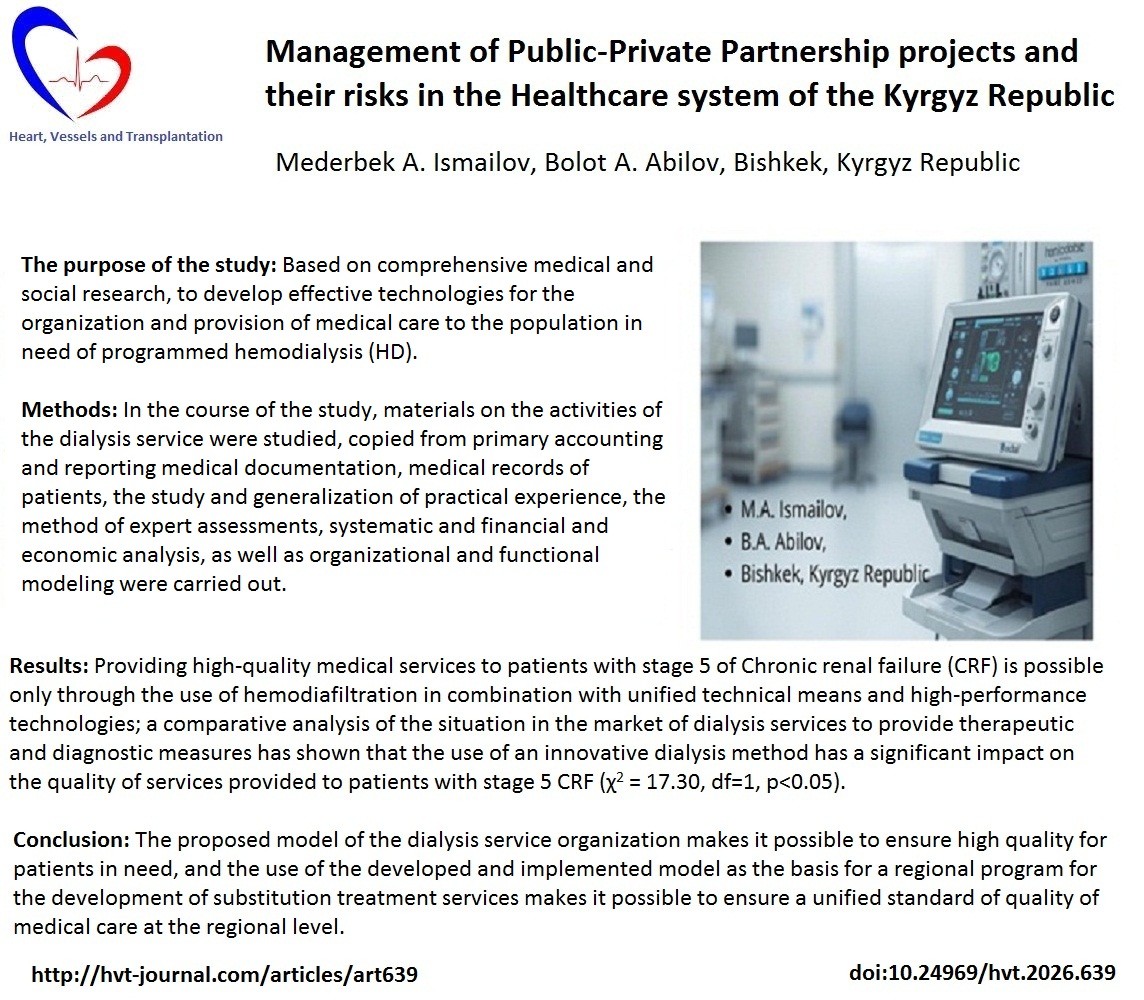
Graphical abstract
Introduction
In the last decade, in most countries of the world, there has been a growing trend in the number of patients in need of dialysis services, that is justifiably classified as one of the most pressing public health and public health problems, and it is due to an increase in the prevalence and mortality from chronic kidney disease (CKD), including in the Kyrgyz Republic (1-6). CKD occupies a significant place among chronic non-communicable diseases due to their widespread occurrence; the logical outcome of the progressive course of CKD is the development of end-stage chronic kidney failure. At this stage of the disease, only the use of methods of renal replacement therapy – hemodialysis (HD) and peritoneal dialysis, along with kidney transplantation – allows saving the patient's life.
The improvement and development of the dialysis service, the creation of a system of social and hygienic monitoring of cases of acute and chronic renal pathology, the implementation of a clear vertical management of this type of specialized medical care, involving all interested social institutions, will not only improve the quality of medical care, but also create a timely prevention program for CKD.
Public-private partnership (PPP) is a very relevant and increasingly in-demand mechanism that allows combining the resources and competencies of the state and business to implement socially significant projects (7-9), especially in conditions of a limited budget.
The level of per capita spending on healthcare was one of the lowest in the WHO European Region (taking into account the country's small Gross Domestic Product (GDP) per capita)). In 2019, per capita healthcare costs amounted to 260 US Dollars in PPP (≈62 Kyrgyz som per US dollar). As a percentage of GDP, healthcare spending in 2019 was 4.5%, while government spending on healthcare was only 2.3% of GDP. The share of personal expenses, which almost entirely take the form of payments from own funds and include informal payments, in 2019 It accounted for 46.3% of healthcare costs; this is lower than the levels that were in 2014-2017, but higher than the levels in the 2000s (10). Current public sector spending on healthcare as a percentage of total government spending, despite rising to 12.8 % in 2005, subsequently showed a downward trend to 7.1% in 2019 (the period of the beginning of implementation the PPP project). In order to ensure the practical implementation and subsequent sustainable functioning of PPP projects, it is necessary to conduct a preliminary analysis and assessment of possible risks (11-14).
The aim of the study was to develop effective technologies for the organization and provision of medical care to the population in need of HD based on a comprehensive medical and social research.
Research objectives:
1. To evaluate the system of organization of medical care at the level of the HD service at the time of preparation of the project.
2. To conduct a comparative analysis of the quality of dialysis centers with different forms of ownership.
3. Based on the research results obtained, to substantiate a new form of providing HD services using innovative approaches to modernize the HD service.
4. Identify the main risks of the PPP project.
Methods
Study design and population
A retrospective observational study was conducted using annual reports on the provision of services in HD in the Kyrgyz Republic. The object of the research was the system of providing medical care to patients with stage 5 CKD who need constant programmed HD. The subject of the study was the organization of a renal replacement therapy service in dialysis centers using the principles and mechanisms of PPP. A retrospective study was carried out to assess the quality of dialysis services and to monitor the state of the hemodialysis service in the republic, taking into account the organizational and legal form of ownership. The design of the study provided for a comparative analysis of the market situation for the provision of dialysis services for these patients in public hospitals and a private operator.
The study was conducted in the period from 2015 to 2020 (from the moment of design to the moment of practical implementation). The study was based on the HD departments of the National Hospital, the M. M. Mirrakhimov National Center of Cardiology and Therapy, the Chui Regional United Hospital, as well as private operators providing hemodialysis services. All of these HD units were located in Bishkek city.
The study included patients who were on HD with a diagnosis of stage 5 CKD. Those under the age of 18 and those who did not undergo regular testing in accordance with national guidelines were excluded from the analysis. We divided patients on basis of provided service – public or private. The first group consisted of patients who were treated in state dialysis units from 2015 to 2018 (n = 60), the second group consisted of patients who received treatment under the PPP project (since 2018, n=223).
As neither patients nor participants were involved in study, the informed consent for participation in the study was not required. Informed consent to the procedures was obtained from all patients included in the study. The Ethics Committee approval is also not required for retrospective study.
Data collection
In the course of the study, materials on the activities of the dialysis service were studied, copied from primary accounting and reporting medical documentation, medical records of patients, the study and generalization of practical experience, the method of expert assessments, systematic and financial analysis, as well as organizational and functional modeling were carried out.
The formation of an array of patients for the subsequent diagnosis of CKD was carried out on the basis of the following criteria (15):
1) kidney damage lasting > 3 months, which manifests itself in the form of structural or functional disorders of the organ with a decrease in glomerular filtration rate (GFR) < 90 ml / min / 1.73 m2;
2) GFR < 90 ml / min / 1.73 m2 for three months, in the absence of other signs of kidney damage;
3) The patient receives renal replacement therapy.
The study of the state of the dialysis service was carried out on the basis of an expert method. This method was used for a retrospective assessment of the quality of medical care based on the analysis of primary medical documentation. The expertise included quality control of the structure, process, and outcome.
The expertise of the activity was carried out on the basis of a systematic approach, using the original methodology of expert assessments.
The list of primary medical and statistical documentation included such documents as: patient record book (Form No.001/u), statistical card of the hospital dropout (No. 066/u), patient movement and bed inventory sheet of the dialysis center (No.007/u) and summary statement of patient movement and bed inventory the Foundation (No. 016/y). To evaluate the activity, an analysis of the main statistical indicators for a certain period of time was carried out with the completion of an appropriate expert card. We used the retrospective and current types of quality assessments.
The retrospective examination was carried out by checking 283 medical records selected by a random sampling method (which is 20.0 % of the sample from the general population – the average number of patients requiring programmed dialysis). Up to 50.0% of medical records subject to examination, selected from among the patients receiving treatment, were subjected to the current examination, which allows timely measures to be taken to correct the examination and treatment of patients.
The definition of the reference values of quality indicators for functional units was carried out in the following order. First of all, the average number of treated patients with a specific nosological form was calculated over a certain period of time. Next, the total values were calculated to determine the ranking ratio of the indicators and the level of their impact on the quality of medical care. The final stage of the study included the development and testing of a model for improving the dialysis service.
We calculated overall number of patients undergoing HD for each analyzed year, absolute increase during subsequent year, growth rate and growth coefficient. We assessed outcomes as mortality, kidney transplant surgery, infections rate and possible causes. We evaluated adequacy of HD, method of treatment, diagnosis and treatment of anemia, diagnosis and treatment of bone disorders, and medicines patients were taking in groups of patients undergoing HD public and private HD centers.
Determining the adequacy of HD
To determine the adequacy of hemodialysis, we used the Daugirdas formula (Kt/V) (5, 16). Kt/V is a generally accepted method for determining the adequacy of hemodialysis. The formula shows how effectively urea is removed relative to the patient's volume of distribution.
The following notation is used in the Kt/V formula:
- K - is the ability of the dialyzer to purify blood from urea;
- t - is the duration of therapy;
- V - is the volume of fluid in the patient's body.
All the necessary laboratory analysis data were used to calculate the dialysis dose using the Kt/V formula, such as: serum creatinine and urea levels before and after dialysis (mmol/L); urea clearance of the dialyzer, dialysis time.
Risk assessment
The risk assessment structure includes: the name of the risk, its description (formulation), the responsible party, the value of the risk, ways to overcome and possible consequences. Degrees of risk (in points): 0-5 points – low risk, the occurrence of which is unlikely; 6-7 points – medium risk, the consequences of which can be reduced, but not excluded; 8-10 points – high risk.
Statistical analysis
The data was processed on a personal computer using the Microsoft Statistica software. Along with the above methods, statistical methods were used to process the research materials. To determine statistically significant differences, the Student’s reliability criterion was used (differences were considered statistically significant at t>2 and a critical significance level of 0.05). To test the significance of the discrepancy between empirical (observed) and theoretical (expected) frequencies, Pearson’s Chi-square test was used. This criterion is necessary for the analysis of categorical data, i.e. those that are expressed not by quantity, but by belonging to a category.
The relationship between the compared indicators was determined by calculating the correlation coefficient using the Pearson method.
Results
Overall, 85.0 % of 283 included in the study were people of working age, of whom 57.0 % were men and 43.0 % were women; 15.0 % were over 60 years old.
At the time of the study, there were eight hemodialysis units providing renal replacement therapy for the treatment of patients with stage 5 CKD. These hemodialysis departments were part of the state health organizations.
Taking into account the existing problems with ensuring citizens’ access to high-quality dialysis services, in 2016 a contract was signed with a private provider to provide HD services. All expenses related to HD were paid from the state budget.
In general, there was an upward trend in the number of patients with CKD, associated with both an increase in the total number of patients with CKD and the number of patients with end-stage kidney disease treated with programmed HD at the expense of the state budget. In 2018, the highest total number of patients with stage 5 CKD who sought medical help and were included in the Registry was recorded, which amounted to 1,252 patients. Table 1 shows data on the number of patients with stage 5 CKD who have received hemodialysis since 2009.
|
Table 1. Data on the number of patients with stage 5 CKD who were on budget dialysis in the Kyrgyz Republic (interval dynamic series) |
||||||||
|
Years |
Patients (abs. number) |
Dynamic range indicators |
|
|||||
|
Absolute increase |
Growth rate 1 (%) |
Growth rate 2 (%) |
Growth coefficient |
1.0% of the display |
|
|||
|
2009 |
68 |
- |
- |
|
- |
- |
|
|
|
2010 |
190 |
+122 |
179.4 |
279.4 |
2.79 |
0.68 |
|
|
|
2011 |
270 |
+80 |
42.1 |
142.1 |
1.42 |
1.90 |
|
|
|
2012 |
304 |
+34 |
12.6 |
112.5 |
1.12 |
2.70 |
|
|
|
2013 |
390 |
+86 |
28.3 |
128.2 |
1.28 |
3.00 |
|
|
|
2014 |
480 |
+90 |
23.1 |
123.0 |
1.23 |
2.80 |
|
|
|
2015 |
549 |
+69 |
14.3 |
114.3 |
1.14 |
4.80 |
|
|
|
2016 |
570 |
+21 |
3.8 |
103.8 |
1.03 |
5.50 |
|
|
|
2017 |
592 |
+22 |
3.8 |
103.8 |
1.03 |
5.80 |
|
|
|
2018 |
622 |
+30 |
5.0 |
105.0 |
1.05 |
6.00 |
|
|
|
CKD – chronic kidney disease |
|
|||||||
The presented data (Table 1) demonstrate an increase in the number of new cases of the disease per year, as well as the total number of patients in general, which confirms the existence of a steady trend towards an increase in the incidence of CKD in the republic. The growth rate of CKD was high in early 2010-2014 then reduced between 2015-2017 and showed small growth in 2018.
The death rate was 9.0 %. The proportion of patients who underwent kidney transplant surgery was low, which was due to the underdevelopment of the transplant service in the republic at that time – 3.0 %.
The proportion of infected patients (only 31.21 %) was explained by a number of reasons:
• Non-compliance with the requirement to treat patients with hepatitis B and C in a separate room (Order of the Ministry of Health of the KR “On measures to prevent the incidence of viral hepatitis in the Kyrgyz Republic” dated July 1, 2009 No. 488 and order “On approval of medical care for patients with stage 3-5 CKD and acute kidney disease in the Kyrgyz Republic” from December 4, 2015, No. 678);
• sufficient time (chemical sterilization) was not always allocated for hygienic treatment of the device between procedures – as a result, when using it for a patient with hepatitis B and / or C, there was a high risk of infection of the next patient;
•or using a clean device for infected patients, which also led to a high risk of infection.
The Table 2 provides an analysis of the situation in the market of dialysis services for providing therapeutic and diagnostic measures. There were statistically significant differences (all p< 0.05) between groups of patients receiving HD private sector and public sectors in terms of adequacy of HD, method of treatment, treatment of anemia and bone disorders, as well taken medicines.
HD was more adequate in group of private sector than in group of state one (p<0.01). It should be noted that only in the dialysis centers of a private partner, dialysis services are provided using the GDF method (a high-flow method using HIGT-FLUX dialyzers and large volumes of dirty plasma replacement with an ultrapure substitute.
The patients receiving HD in private center were monitored for anemia more frequently (p<0.001 )using advanced laboratory analysis as not only morphological picture of red blood and iron levels, but also using iron exchange function with estimated % saturation of transferrin and phosphorus-calcium metabolism and for bone diseases not only phoshoprus elevel but also total and ionized calcium levels, alkaline phosphatase, parathyroid hormone levels were evaluated every 3 months (p<0.001). Patients in private HD center received medical treatment according to EU standards, while in public sector they received minimal list of medicines (p<0.05).
|
Table 2. Comparative analysis in relation to the situation in the market of dialysis services for providing therapeutic and diagnostic measures |
|
Criteria |
Private partner |
Public hospitals |
p |
|
In 90% of patients, Kt/V (dialysis dose) ≥ 1.3* |
1.69 (0.01) (95% CI 1.4-1.8-2.0) |
1.25 (0.01) (95% CI 1.2-1.3) |
< 0.01 |
|
The method of treatment |
They provide programmatic treatment with a high–precision HRT method – hemodiafiltration (GDF). All procedures are 100.0% GDF |
Low-flow dialysis method |
< 0.05 |
|
Diagnosis and treatment of anemia in patients |
The morphological picture of red blood, iron exchange function with estimated % saturation of transferrin, phosphorus-calcium metabolism are monitored |
Only red blood and iron levels are monitored |
< 0.001 |
|
Diagnosis and treatment of bone disorders |
Total and ionized calcium levels, alkaline phosphatase, parathyroid hormone levels every 3 months |
Only the blood phosphorus level is determined |
< 0.001 |
|
Medicines |
List of drugs in accordance with European standards |
The minimum list |
< 0.05 |
|
*-data are presented as mean (SE) 95%CI t-test for independent samples, Chi-square test |
|||
Conjugacy tables are a means of visualizing the combination of "outcome factor" frequencies and a substrate for calculating the Pearson square to obtain a reliable answer about the randomness or non-randomness of the results of the study. Based on the above, an assessment was made of the impact of the use of the new dialysis method on the dynamics of the compared indicators of the values of the Chi-square with a critical value (for the degree of freedom of 1, and a significance level of 3.841). The result was Chi-square = 17.30, with df=1, p<0.05.
Discussion
Our study demonstrated growth of CKD stage 5 in Kyrgyz Republic for the period of 2010-2018 with more intense and lower rates. We showed also that indicator of adequacy of HD in private sector was significantly higher than in public sector. Our analysis supports the fact that the use of an innovative dialysis method has a significant impact (Chi-square = 17.30, with df=1, p<0.05.) on the quality of services provided to patients with stage 5 CKD.
With regard to the status of hemocontact infections, a decrease in the number of infected from 21.0 to 19.8 % should be noted, while the values with a pure hemocontact status, on the contrary, increased from 79.0 to 80.2 %. Given the conditions created in the centers, where patients with different statuses are received in separate rooms, on separate devices, the risk of nosocomial infection is reduced to zero. Data on mortality and infection of patients during the period of PPP dialysis are provided in a subsequent article. Currently, PPP is a new innovative direction in the KR as a whole, which has a direct impact on the public health sector, even taking into account the previous practice of outsourcing hemodialysis services based on an agreement with a local private company. It should be noted that we have identified nine long–term risks, three of which are identified as medium, and the remaining six as high-level risks.
The main risks of the PPP project include:
1. Non-compliance with the National Standard by a private partner;
2. Late payment for services by a government partner;
3. Change in the price of a dialysis session;
4. Suspension of dialysis services;
5. Bankruptcy / liquidation of a private partner.
The analysis carried out using the example of a specific PPP project in the healthcare system made it possible to identify and assess the risks inherent in it.
The need for risk assessment and analysis is an indispensable condition for the subsequent practical functioning of PPP projects in the sectors of the republic's economy. The mentioned literature sources (7-9) did not provide comparative data between public hospitals and a private operator.
Study limitations
This study has several limitations that should be considered when interpreting the results: Retrospective design. The analysis was conducted using existing medical documentation, which limits the ability to account for all clinical factors and specific features of therapy.
Conclusions
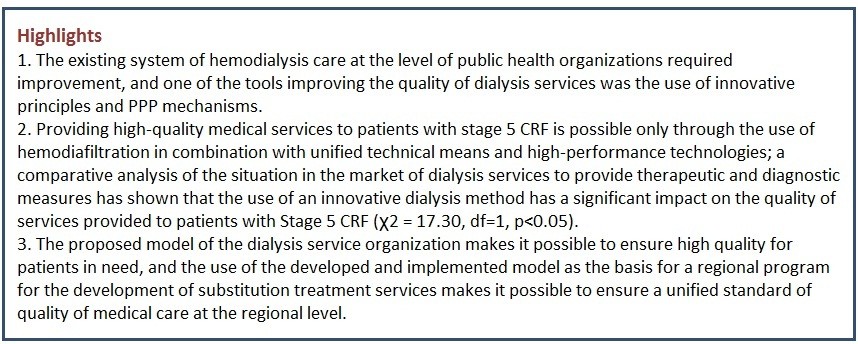
1. The existing system of hemodialysis care at the level of public health organizations required improvement, and one of the tools improving the quality of dialysis services was the use of innovative principles and PPP mechanisms.
2. Providing high-quality medical services to patients with stage 5 CKD is possible only through the use of hemodiafiltration in combination with unified technical means and high-performance technologies; a comparative analysis of the situation in the market of dialysis services to provide therapeutic and diagnostic measures has shown that the use of an innovative dialysis method has a significant impact on the quality of services provided to patients with stage 5 CKD (Chi-square = 17.30, df=1, p<0.05).
3. The proposed model of the dialysis service organization makes it possible to ensure high quality HD for patients in need, and the use of the developed and implemented model as the basis for a regional program for the development of substitution treatment services makes it possible to ensure a unified standard of quality of medical care at the regional level.
Ethics: As neither patients nor participants were involved in study, the informed consent for participation in the study was not required. Informed consent to the procedures was obtained from all patients included in the study. The Ethics Committee approval is also not required for retrospective study.
Peer-review: External and internal
Conflict of interest: None to declare
Authorship: M.A.I. and B.A.A. equally contributed to the study and preparation of manuscript, thus fulfilled all authorship criteria
Acknowledgement and funding: None to declare.
Statement on A.I.-assisted technologies use: The authors did not use AI-assisted technologies in preparation of this manuscript.
Data and material availability: Contact authors. Any sharing should be in form of collaboration and fair use with acknowledgement of source.
References
| 1. Babaev FG. Ways to improve extracorporeal treatment of chronic kidney disease in Azerbaijan. Abstract of the dissertation of Doctor of Medical Sciences: 14.02.03. Bishkek, 2024: 45 p. | ||||
| 2. Yesayan AM. Chronic kidney disease: Risk factors, earlier detection, principles of antihypertensive therapy. Med Advice 2017; 12: 18-25. doi:10.21518/2079-701X-2017-12-18-25 https://doi.org/10.21518/2079-701X-2017-12-18-25 |
||||
| 3. Zholdoshev KY. Substitution therapy of chronic kidney diseases: problems and solutions. Bull Intern Univ Kyrgyzstan 2015; 27: 133-7. | ||||
| 4. Kaliev RR, Ayypova DA, Beishebayeva NA. Clinical guidelines for the management of patients with chronic kidney disease. Bishkek 2019: 190p. | ||||
| 5.Daugirdas JT. Hemodialysis treatment time: As important as it seems? Semin Dial 2017; 30: 93-8. doi: 10.1111/sdi.12575 https://doi.org/10.1111/sdi.12575 PMid:28092113 |
||||
| 6. Karaboyas A., Zee J, Brunelli SM, Usvyat LA, Weiner DE, Maddux FW, et al. Dialysate potassium, serum potassium, mortality, and arrhythmia events in hemodialysis: results from the dialysis outcomes and practice patterns study (DOPPS). Am J Kidney Dis 2017; 69: 266-77. doi: 10.1053/j.ajkd.2016.09.015 https://doi.org/10.1053/j.ajkd.2016.09.015 PMid:27866964 PMCid:PMC5520979 |
||||
| 7. Batyraliev TA, Ismailov MA, Abilov BA. Implementation of public-private partnership in the healthcare system. Problems and prospects. Lambert Academic Publishing; Germany 2017: 60p. | ||||
| 8. Dzhaparova D. The condition for the successful development of public-private partnership is risk management. Reform 2022; 4: 47-56. | ||||
| 9. Ledyaeva NY, Pogorelov IZ. Proposals for improving risk management in the mechanism of public-private partnership. Logist Systems Glob Econ 2021; 11: 218-20. | ||||
| 10. Moldoisaeva S, Kaliev M, Sydykova A, Muratalieva E, Ismailov M, Madureira Lima J, et al. Kyrgyzstan: Healthcare system. Health Syst Transit 2022; 24: 1-180. | ||||
| 11. Kharkova OM. Risk management in the implementation of transport projects within the framework of public-private partnership. Bull Acad Knowledge 2022; 51: 318-28. | ||||
| 12. Shepilova VG, Cherkashina TV. Theoretical approaches to risk management in public-private partnership projects in tourism. Collection of scientific papers of the series "Public Administration" 2022; 28: 107-23. | ||||
| 13. Wang Y, Wang Y, Wu X. Exploring the risk factors of infrastructure PPP projects for sustainable delivery: A social network perspective. Sustainability 2020; 12: 41-52. doi: 10.3390/su12104152 https://doi.org/10.3390/su12104152 |
||||
| 14. Zimmermann J, Wolfgang E. Consideration of risk in PPP-Projects. Bus Manag Educ 2014; 12: 30-46. https://doi.org/10.3846/bme.2014.03 |
||||
| 15. Levy AS, Eckardt KU, Dorman NM, Christiansen SL, Hoorn EJ, Ingelfinger JR, et al. Nomenclature for kidney function and disease: report of Kidney Disease: Improving Global Outcomes (KDIGO) Consensus conference. KDIGO Conference report 2020; 97: 1117-29. https://doi.org/10.1016/j.kint.2020.02.010 https://doi.org/10.28996/2618-9801-2020-3-271-292 |
||||
| 16.Daugirdas JT. Second generation logarithmic estimates of single-pool variable volume Kt/V: an analysis of error. J Am Soc Nephrol 1993; 4: 1205-13. https://doi.org/10.1681/ASN.V451205 PMid:8305648 |
||||
Copyright

This work is licensed under a Creative Commons Attribution-NonCommercial 4.0 International License.
AUTHOR'S CORNER