The 2025 AHA/ACC and 2024 ESC hypertension guidelines: From blood pressure thresholds to risk trajectories
EDITORIALS
The 2025 AHA/ACC and 2024 ESC hypertension guidelines: From blood pressure thresholds to risk trajectories
Article Summary
- DOI: 10.24969/hvt.2026.654
- CARDIOVASCULAR DISEASES
- Published: 25/05/2026
- Received: 19/05/2026
- Accepted: 20/05/2026
- Views: 1161
- Downloads: 370
- Keywords: Hypertension, risk stratification, guidelines, single-pill combinations
Address for Correspondence: Zhenisgul Tlegenova, Department of Internal Diseases 2, West Kazakhstan Marat Ospanov Medical University, Aktobe, Kazakhstan
Email: zhenisgul.tlegenova@zkmu.kz Mobile: +7 707 4998565
ORCID: Yerlan Sagymbay - 0009-0003-7353-7407; Aiganym Amanova - 0009-0001-9787-7583; Zhenisgul Tlegenova –0000-0002-3707-7365
Yerlan Sagymbay1,2, Aiganym Amanova1, Zhenisgul Tlegenova1*
1West Kazakhstan Marat Ospanov Medical University, Aktobe, Kazakhstan
2Hospital of the Medical Center Administration of the President of the Republic of Kazakhstan, Astana, Kazakhstan
Key words: Hypertension, Risk stratification, Guidelines, Single-pill combinations
Introduction
Hypertension remains the most prevalent and modifiable risk factor driving cardiovascular (CV) complications and disabling conditions, including coronary artery disease, heart failure, atrial fibrillation, stroke, vascular dementia, chronic kidney disease (CKD), and mortality (1). The publication of the 2024 European Society of Cardiology (ESC) guidelines and the 2025 American Heart Association/American College of Cardiology (AHA/ACC) guideline mark an important transition in preventive cardiology, redefining the boundaries of CV risk management (2, 3). This transition shifts hypertension management away from treating isolated high blood pressure (BP) toward proactive control of long-term CV risk trajectories. The AHA/ACC guideline adopts a proactive, risk-oriented framework grounded in lifetime CV risk assessment, whereas the ESC model favors a more calibrated strategy balancing preventive intensity against the risks of overtreatment and polypharmacy. Fundamentally, this academic debate unfolds against a background of pervasive “clinical inertia” - a persistent tendency among practitioners to mistake hemodynamic stability for therapeutic success. Crucially, a modestly elevated yet year-over-year «stable» BP in an adult patient is not a clinical victory; rather, it represents a period of silent biological accumulation of CV risk that contributes to end-organ damage (4).
The aim of this editorial is to compare the 2025 AHA/ACC and 2024 ESC hypertension guidelines, focusing on their diagnostic thresholds, risk-stratification models, treatment-initiation strategies, therapeutic targets, lifestyle recommendations, and implementation challenges in the context of reducing clinical inertia and improving long-term cardiovascular prevention.
Graphical abstract

Diagnostic criteria and systemic surveillance
The first fundamental paradigm shift relates to the classification of BP categories. The 2025 AHA/ACC guideline maintains strict continuity with the 2017 criteria, defining Stage 1 hypertension at a systolic BP of 130-139 mm Hg or a diastolic BP of 80-89 mm Hg. The American guideline maintains this lower diagnostic threshold to enable early intervention and potentially mitigate subclinical vascular remodeling at an early stage. The 2024 ESC guidelines introduced the new category of «elevated BP» (120-139/70-89 mm Hg), while reserving the formal diagnosis of hypertension for BP values =140/90 mmHg. The European approach aims to reduce exposure of low-risk populations to premature pharmacotherapy. Both the 2024 and 2025 guidelines reaffirm that office BP measurement remains the cornerstone of hypertension diagnosis. Concurrently, home blood pressure monitoring (HBPM) and ambulatory blood pressure monitoring (ABPM) are positioned as important tools for diagnostic verification, the identification of white-coat and masked hypertension, and the optimization of long-term BP control.
In this context, both guidelines emphasize that HBPM should be performed only with validated devices. The 2025 AHA/ACC guideline advises against the clinical use of cuffless BP devices (including smartwatches) for clinical decision-making until robust validation data become available. Both guidelines intensify focus on the systemic underdiagnosis of secondary endocrine hypertension (2, 3).
While the 2024 ESC guidelines suggest that screening for primary aldosteronism should be considered in all adults with confirmed hypertension =140/90 mm Hg (Class IIa), the 2025 AHA/ACC framework implements a more targeted screening strategy. Specifically, the American guideline elevates screening to a Class I recommendation for high- risk cohorts - including individuals with resistant hypertension, hypokalemia, adrenal incidentalomas, or severe systolic blood pressure (SBP) =160 mm Hg - while maintaining a Class IIa recommendation for opportunistic screening in all newly diagnosed hypertensive adults.
Risk stratification: PREVENT and SCORE2
The second paradigm shift involves transitioning from isolated atherosclerotic event estimation to broader cardiovascular-kidney-metabolic risk assessment. AHA/ACC 2025 has incorporated the PREVENT risk tool, which calculates both 10-year and 30-year (lifetime) cardiovascular disease (CVD) risk for individuals aged 30-79 years by embedding chronic kidney disease (CKD) markers and heart failure risks into its core algorithm (6). Conversely, the 2024 ESC guidelines rely on the SCORE2 risk algorithms for individuals aged 40-69 years and ≥70 years (SCORE2-OP), respectively. SCORE2 is predominantly calibrated to atherosclerotic CVD outcomes and may classify some patients into higher-risk categories compared with the PREVENT engine (7).
AHA/ACC 2025 stratifies patients via the PREVENT score: immediate pharmacotherapy is indicated for individuals with established clinical CVD, or for those without clinical CVD but presenting with diabetes, CKD, or an estimated 10-year PREVENT risk of >7.5%. However, if the calculated risk remains <7.5%, the guideline recommends an initial 3-6-month period of intensive lifestyle modification before pharmacologic escalation in lower-risk individuals (2).
ESC 2024 operates through the lens of strict clinical criteria for high-risk categories. Within the elevated BP spectrum, immediate pharmacotherapy is recommended for patients with automatically verified high or very high risk (co-existing associated CV diseases, moderate-to- severe CKD, diabetes, or familial hypercholesterolemia) (3). In cases of borderline increased risk (5% to <10%), the new concept of risk modifiers - non-traditional CV diseases risk modifiers, including gender-specific, has been proposed. This approach ultimately allows initiation of pharmacological therapy for elevated BP under certain conditions. In high-risk individuals with elevated BP, the 2024 ESC guideline recommends a short initial period of lifestyle intervention, approximately 3 months, followed by pharmacological therapy if BP remains =130/80 mm Hg or if lifestyle measures are not successfully implemented (Class I level A) (3). Consequently, a profound point of convergence emerges: in low-to-moderate risk individuals presenting with BP within the 130-139/80-89 mm Hg range, both societies recommend initial lifestyle-based management (3-6 months in the US vs. 3 months in Europe), thereby aiming to protect uncomplicated patients from unnecessary polypharmacy (2, 3).
Therapeutic trajectories, intensive lowering, and systemic barriers
When lifestyle modification proves insufficient, the current treatment strategies emphasize a rapid and sustained trajectory toward target values. Both guidelines unanimously endorse the initiation of pharmacotherapy with a dual single-pill combination comprising two first-line agents from different drug classes, a strategy proven to minimize time-to-control and enhance patient adherence. However, important differences remain: AHA/ACC 2025 primarily recommends initial dual single-pill combination therapy for Stage 2 hypertension, while monotherapy remains reasonable for many patients with Stage 1 hypertension (2). ESC 2024 expands the scope of monotherapy, recommending its use in uncomplicated elevated BP and explicitly extending it to very elderly patients (>85 years), frail individuals, and those prone to severe orthostatic hypotension (3). In the AHA/ACC 2025 guideline, the universal therapeutic target for most adults remains <130/80 mm Hg. However, the document emphasizes evidence from intensive BP-lowering trials, particularly SPRINT, supporting additional CV benefit from achieving systolic BP levels approaching <120 mm Hg when clinically feasible and well tolerated (8). The ESC 2024 guideline establishes a more conservative lower safety boundary, defining a target window of 120-129/70-79 mm Hg and discouraging SBP reduction below 120 mm Hg to preserve vital organ perfusion (3). For patients over 85 years, ESC 2024 guideline incorporates the geriatric ALARA (As Low As Reasonably Achievable) principle (<140 mm Hg). Crucially, these data support the concept that the velocity and stability of reaching BP targets are independent determinants of survival, demonstrating that patients who achieve a rapid and stable BP control experience the lowest rates of major strokes. Because patients often fear the profound disability associated with an acute stroke - the sudden loss of speech, mobility, and independence - more than death itself, achieving target BP stands as an important patient-centered goal (4). This objective is difficult to achieve within the traditional model of episodic clinic visits.
Overcoming therapeutic inertia requires systems-level transformation: deploying automated EHR-based surveillance, leveraging continuous digital transmission of patient-generated home data, and embedding multidisciplinary team-based care models (integrating physicians, pharmacists, nurses, dietitians, and social workers) designed to reduce structural barriers to BP control (9).
Lifestyle modifications: Behavioral interventions vs. macro-nutritional controls
Within the non-pharmacological domain, where both societies theoretically position the DASH diet as a foundational cornerstone, distinct strategic priorities emerge: ESC 2024 advocates for population-level nutritional strategies, strongly emphasizing the reduction in sugar-sweetened beverage intake from early childhood and recommending that free sugars be restricted to 10% of total energy intake (3). It also places the Mediterranean diet on an equal footing with DASH (3). AHA/ACC 2025 places a distinct emphasis on clinical-behavioral models. The guideline introduces formal recommendations for targeted potassium supplementation as an adjunctive therapeutic strategy in patients without CKD (2). Furthermore, it includes evidence-based stress-reduction protocols (including breathing-control techniques, yoga, and transcendental meditation), highlighting that the latter can reliably achieve a mean BP reduction of 5/2 mm Hg - a modest yet clinically relevant contribution to non-pharmacological management (10).
Conclusion
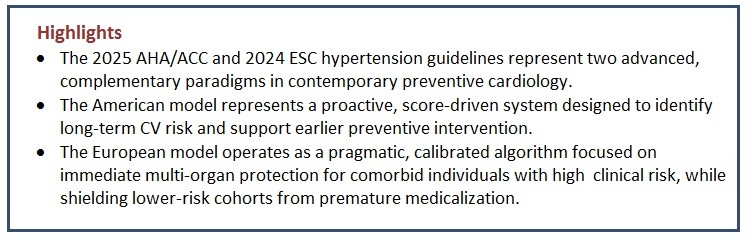
The 2025 AHA/ACC and 2024 ESC hypertension guidelines represent two advanced, complementary paradigms in contemporary preventive cardiology. The American model represents a proactive, score-driven system designed to identify long-term CV risk and support earlier preventive intervention. The European model operates as a pragmatic, calibrated algorithm focused on immediate multi-organ protection for comorbid individuals with high clinical risk, while shielding lower-risk cohorts from premature medicalization.
In the era of digital healthcare and artificial intelligence, the major challenge is to shatter the clinical illusion of stability and reduce therapeutic inertia through team-based care infrastructure. Practicing clinicians must embrace the core conclusion: what was once considered "intensive therapy" must now be recognized for what it truly is - simply the standard for high-quality medical care.
Peer-review: Internal
Conflict of interest: None to declare
Authorship: Ye.S., A.A., and Zh.T. equally contributed to manuscript preparation and fulfilled authorship criteria.
Acknowledgements and Funding: None to declare.
Statement on A.I.-assisted technologies use: During the preparation of this work, the
authors used Gemini (Google, Mountain View, CA, USA) in order to improve the language and
grammar of the manuscript. After using this tool, the authors reviewed and edited the content and
took full responsibility for the overall content of the publication.
Data and material availability: Not applicable
References
| 1. World Health Organization. Global report on hypertension: the race against a silent killer. World Health Organization. 2023. Available at: URL: | ||||
| https://www.who.int/publications/i/item/9789240081062?ysclid=mp8dt2wor7787172739 | ||||
| 2. Jones DW, Ferdinand KC, Taler SJ, Johnson HM, Shimbo D, Abdalla M, et al. 2025 AHA/ACC/AANP/AAPA/ABC/ACCP/ACPM/AGS/AMA/ASPC/NMA/PCNA/SGIM guideline for the prevention, detection, evaluation, and management of high blood pressure in adults: A Report of the American College of Cardiology/American Heart Association Joint Committee on Clinical Practice Guidelines. J Am Coll Cardiol 2025; 86: 1567- 678. doi: 10.1016/j.jacc.2025.05.007. https://doi.org/10.1016/j.jacc.2025.05.007 PMid:40815242 PMCid:PMC12976873 |
||||
| 3. McEvoy JW, McCarthy CP, Bruno RM, Brouwers S, Canavan MD, Ceconi C, et al. ESC Scientific Document Group. 2024 ESC Guidelines for the management of elevated blood pressure and hypertension. Eur Heart J 2024; 45: 3912-4018. doi: 10.1093/eurheartj/ehae178 https://doi.org/10.1093/eurheartj/ehae178 PMid:39210715 |
||||
| 4. Krumholz HM. When "intensive" becomes standard: Hypertension, stroke, and the cost of clinical inertia. J Am Coll Cardiol 2026; 87: 2335-7. doi: 10.1016/j.jacc.2026.03.074 https://doi.org/10.1016/j.jacc.2026.03.074 PMid:42126149 |
||||
| 5. Whelton PK, Carey RM, Aronow WS, Casey DE Jr, Collins KJ, Dennison Himmelfarb C, et al. 2017 ACC/AHA/AAPA/ABC/ACPM/AGS/APhA/ASH/ASPC/NMA/ PCNA guideline for the prevention, detection, evaluation, and management of high blood pressure in adults: Executive Summary: A Report of the American College of Cardiology/American Heart Association Task Force on Clinical Practice Guidelines. Circulation 2018; 138: e426-83. doi: 10.1161/CIR.0000000000000597 https://doi.org/10.1161/CIR.0000000000000597 |
||||
| 6. Khan SS, Matsushita K, Sang Y, Ballew SH, Grams ME, Surapaneni A, et al. Chronic Kidney Disease Prognosis Consortium and the American Heart Association Cardiovascular-Kidney-Metabolic Science Advisory Group. Development and Validation of the American Heart Association's PREVENT Equations. Circulation 2024; 149: 430- 49. doi: 10.1161/CIRCULATIONAHA.123.067626 https://doi.org/10.1161/CIRCULATIONAHA.123.067626 PMid:37947085 PMCid:PMC10910659 |
||||
| 7. Ozpelit ME, Colak A, Uzumcu HI, Kumral Z, Ozpelit E. Correlation and agreement between the SCORE2 and PREVENT 10-year atherosclerotic cardiovascular disease risk scores: Insights from coronary computed tomography angiography. Diagnostics (Basel) 2024; 14: 2625. doi: 10.3390/diagnostics14232625 https://doi.org/10.3390/diagnostics14232625 PMid:39682534 PMCid:PMC11640182 |
||||
| 8. SPRINT Research Group; Wright JT Jr, Williamson JD, Whelton PK, Snyder JK, Sink KM, Rocco MV, et al. A randomized trial of intensive versus standard blood- pressure control. N Engl J Med 2015; 373: 2103-16. doi: 10.1056/NEJMoa1511939 https://doi.org/10.1056/NEJMoa1511939 PMid:26551272 PMCid:PMC4689591 |
||||
| 9. Hundemer GL, Goupil R. Implementing the 2025 guideline for the prevention, detection, evaluation, and management of high blood pressure in adults: How to translate team- based care of hypertension to the real world. Hypertension 2025; 82: 1535-7. doi: 10.1161/HYPERTENSIONAHA.125.25464 https://doi.org/10.1161/HYPERTENSIONAHA.125.25464 PMid:40961215 |
||||
| 10. Ooi SL, Giovino M, Pak SC. Transcendental meditation for lowering blood pressure: An overview of systematic reviews and meta-analyses. Complement Ther Med 2017; 34: 26- 34. doi: 10.1016/j.ctim.2017.07.008 https://doi.org/10.1016/j.ctim.2017.07.008 PMid:28917372 |
||||
Copyright

This work is licensed under a Creative Commons Attribution-ShareAlike 4.0 International License.
AUTHOR'S CORNER