Exploring the connection between serum magnesium and exacerbation of chronic obstructive pulmonary disease
ORIGINAL RESEARCH ARTICLE
Exploring the connection between serum magnesium and exacerbation of chronic obstructive pulmonary disease
Article Summary
- DOI: 10.24969/hvt.2026.655
- CARDIOVASCULAR DISEASES
- Published: 25/05/2026
- Received: 04/04/2026
- Revised: 15/05/2026
- Accepted: 15/05/2026
- Views: 392
- Downloads: 306
- Keywords: Serum magnesium, chronic obstructive pulmonary disease, hospital stay, hypomagnesemia, acute exacerbation, respiratory failure, mechanical ventilation, severity of diseases, outcome
Address for Correspondence: Ramya Gadam, Department of Pulmonary Medicine, Government General Hospital, Rangaraya Medical College, Kakinada, India
Email: g.ramya1208@gmail.com Mobile: +93 9505455995
Chirukuri Venkata Rohitha Chowdary, Vathada Nookaraju, Ramya Gadam*, Aravindhan Rajesh, Mekapothula Sravanthi
Department of Pulmonary Medicine, Government General Hospital, Rangaraya Medical College, Kakinada, India
Abstract
Objective: This study aims to determine the association of serum magnesium level in chronic obstructive pulmonary disease (COPD) patients and its relationship with exacerbations, duration of hospital stay and mortality outcome.
Methods: A prospective observational study was conducted among 100 COPD patients who presented to Government General Hospital, Kakinada over a period of 3 months (January to March 2025) and their serum magnesium levels were measured. COPD was diagnosed clinically/spirometry according to GOLD 2024 Guidelines. Patients were followed-up during hospital stay for exacerbations of COPD, development of respiratory failure and need for ventilation, mortality. Chi square test was used for statistical analysis.
Results: Out of 100 patients, 45 had hypomagnesemia, 46 - normal magnesium levels, and 9 - hypermagnesemia. Among the 45 patients with hypomagnesemia, 36 required hospital admission (p<0.001). Respiratory failure was observed in 23 patients, of whom 4 required invasive mechanical ventilation and 19 required non-invasive mechanical ventilation, hypomagnesemia was more frequent in patients with respiratory failure and need for ventilation (p<0.001). Prolonged hospital stay (>7 days) was noted in 23 patients with hypomagnesemia but did not reach significance. There was an association between hypomagnesemia in severe and very severe COPD (p=0.03). Overall, 3 patients with hypomagnesemia and 4 patients with normal magnesium levels succumbed.
Conclusion: Hypomagnesemia is a common finding in COPD patients who needs hospitalization. The low level of magnesium is also related to the severity of COPD and respiratory failure requiring ventilation. Magnesium therefore can be a risk factor for COPD exacerbation. This is an easily modifiable risk factor.
Key words: Serum magnesium, chronic obstructive pulmonary disease, hospital stay, hypomagnesemia, acute exacerbation, respiratory failure, mechanical ventilation, severity of diseases, outcome
Introduction
Although chronic obstructive pulmonary disease (COPD) is preventable and treatable, it remains a major public health problem (1). Exacerbation is more likely among patients who are older, have a lower forced expiratory volume 1 (FEV1) percentage, who are at an advanced stage of the illness, have poor performance status, anxiety or depression, and have a worse quality of life, as well as a history of frequent exacerbations, and hypercapnia (1). Exacerbations are more likely among patients with hypomagnesemia (2-10).
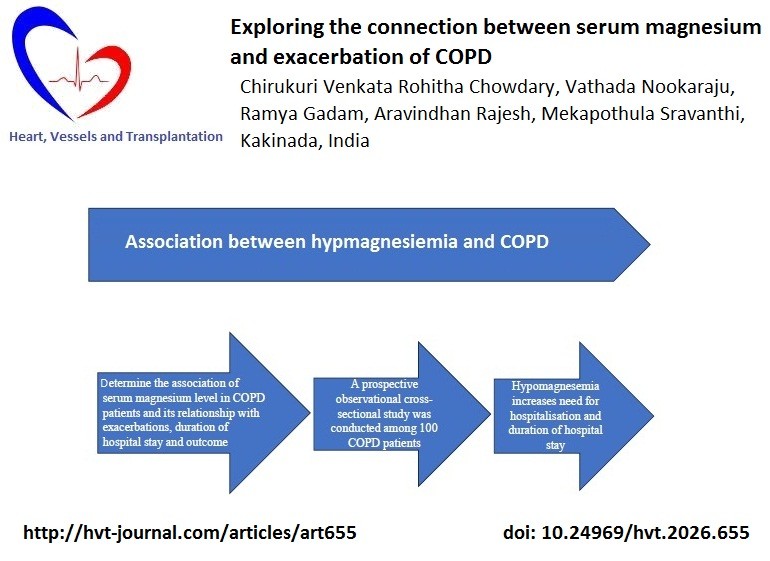
Graphical abstract
Magnesium plays a vital role in respiratory health (9). Magnesium is hypothesized to have a preventive impact against chronic respiratory tract disorders because of its role in bronchodilation and relaxation of respiratory tract smooth muscles (11), mast cell stability, neurohumoral mediator release, and mucociliary clearance. Since lower muscular strength and greater airway hyperreactivity are both related with hypomagnesemia, which is a treatable risk factor, magnesium may help keep patients with COPD stable.
This study aims to determine the association of serum magnesium level in COPD patients and its relationship with exacerbations, respiratory failure and need for ventilation, duration of hospital stay and outcome.
Methods
Study design and population
It is a prospective observational cohort study conducted on 100 consecutive patients with COPD attending the department of pulmonary medicine of Kakinada General Government hospital over a period of 3 months (January to March 2025). Patients with bronchial asthma, age <40 years and conditions causing hypomagnesemia like renal causes of acute tubular necrosis, chronic diarrhea, vomiting, Crohn’s disease, ulcerative colitis, taking drugs as loop diuretics, thiazides, gentamycin, cisplatin were excluded from the study.
Institutional ethics committee approval was obtained and patient informed consent was taken for all procedures and study participation. Study is complied with the Declaration of Helsinki 2024 rules for human studies.
Baseline variables
We collected data as age, sex, severity of COPD, admission to the hospital or outpatient status, smoking status, biomass exposure, duration of hospital stay, and inhaler use.
COPD diagnosis
COPD was diagnosed by having a positive history of dyspnea (progressive, exertional or persistent), chronic cough (may be intermittent or non-productive), chronic sputum and history of exposure to tobacco, occupational dusts, chemicals or other smokes after the age of 40.
The diagnosis of COPD was confirmed by having a positive history and FEV1/forced volume capacity (FVC) less than 70% after applying bronchodilator in spirometry and severity of COPD (mild, moderate, severe and very severe) was taken according to GOLD guideline (1).
Serum magnesium
The serum magnesium level was measured in all patients at admission by colorimetry using the Merylzer AutoQuant 200 Excelus (India) fully automated biochemistry analyzer. Serum magnesium (Mg) level <1.7 mg/dl is considered hypomagnesemia and levels >2.4 mg/dl is considered hypermagnesemia.
Outcome variables
Patients were followed up in hospital for the development of respiratory failure requiring non-invasive and mechanical ventilation, exacerbation of COPD, mortality and duration of hospital stay.
Statistical analysis
SPSS for Windows (IBM, New York, USA) was used for statistical analysis. Data are presented as number of observations. Chi square test was used for comparison of frequencies between groups. A p<0.05 was accepted as statistically significant.
Results
Baseline characteristics of COPD patients
Out of 100 patients, 66 were males and 34 were females with age preponderance of 60-70 years. Among cohort, 33 were active smokers, ex-smokers were 39, second-hand smokers were 8, biomass exposed people were 5, 15 had no exposure to any of the above. Of Inhaler therapy was used by 18 with moderate COPD, 20 with severe and 5 patients with very severe COPD. Distribution of COPD severity was as follows: mild in 26 patients, moderate – 36 patients, severe -30 patients and very severe – 8 patients.
Magnesium levels and clinical course, outcomes of COPD patients
Of 100 patients, 53 were admitted and 47 were treated on outpatient basis (Table 1). Of 53 inpatients, 36 had low magnesium levels, 15 had normal and 2 had higher magnesium levels. Out of 47 outpatients, 9 had low magnesium levels, 31 had normal and 7 had higher magnesium levels. There was a statistically significant association between serum magnesium levels and COPD exacerbation requiring hospital admission (χ² = 24.27, df = 2, p < 0.0001). Patients with hypomagnesemia showed a higher rate of hospitalization compared to patients with normal or elevated magnesium levels.
|
Table 1. Serum magnesium level in admitted to hospital and outpatient patients |
|||
|
Serum magnesium, n |
Admission to hospital |
Outpatient |
Total, n |
|
Hypomagnesiemia |
36 |
9 |
45 |
|
Normal |
15 |
31 |
46 |
|
Hypermagnesiemia |
2 |
7 |
9 |
|
Total, n |
53 |
47 |
100 |
|
Chi-square test, p<0.0001 |
|||
Of 53 inpatients, 33 had type 2 respiratory failure and 20 patients had no respiratory failure (Table 2). Among 33 type 2 respiratory failure patients 24 required non-invasive ventilation and 9 required invasive ventilation. Among 24 non-invasive ventilated patients, 19 had hypomagnesemia, 3 had normal magnesium levels and 2 had hypermagnesemia. Among 9 invasive ventilated patients 4 had low magnesium levels, 5 had normal magnesium levels. There was a statistically significant association between serum magnesium levels and type 2 respiratory failure with need for ventilation (p<0.001). Patients with hypomagnesemia showed a higher rate of non-invasive mechanical ventilation.
There was significant association between COPD severity and magnesium groups (p=0.03), with significantly higher number of patients with hypomagnesemia in severe and very severe COPD groups (Table 3).
|
Table 2. Distribution of admitted to hospital patients requiring invasive and non-invasive ventilation according to serum magnesium level (n=53) |
||||
|
Serum magnesium, n |
Type 2 respiratory failure |
No respiratory failure |
Total, n |
|
|
Non-invasive ventilation |
Invasive ventilation |
|||
|
Hypomagnesemia |
19 |
4 |
13 |
36 |
|
Normal |
3 |
5 |
7 |
15 |
|
Hypermagnesemia |
2 |
- |
2 |
|
|
Total, n |
24 |
9 |
20 |
53 |
|
Chi-square test, p<0.001 |
|
|||
|
Table 3. Comparison of serum magnesium levels according to COPD severity (n=100) |
||||
|
Serum magnesium, n |
Severity of COPD, n |
|||
|
Mild |
Moderate |
Severe |
Very Severe |
|
|
Hypomagnesemia |
6 |
16 |
16 |
7 |
|
Normal |
15 |
17 |
13 |
1 |
|
Hypermagnesemia |
5 |
3 |
1 |
0 |
|
Total, n |
26 |
36 |
30 |
8 |
|
Chi-square test, p=0.03 COPD – chronic obstructive pulmonary disease |
||||
As to hospital stay duration (Table 4), of 53 inpatients duration of hospital stay 22 patients had < 7 days duration in and 31 patients stayed ≥7 days. Among 22 patients 13 had low magnesium levels, 9 had normal magnesium levels. Among 31 patients with long hospital stay, 23 had low magnesium levels, 6 - normal magnesium levels, and 2 had high magnesium levels. Though more patients with hypomagnesemia stayed longer than a week, it was not statistically significant (p>0.05).
|
Table 4. duration of hospital stay of admitted patients according to magnesium levels (n=53) |
|||
|
Serum magnesium, n |
Duration of hospital stay |
Total, n |
|
|
<7 days |
≥7 days |
||
|
Hypomagnesiemia |
13 |
23 |
36 |
|
Normal |
9 |
6 |
15 |
|
Hypermagnesiemia |
0 |
2 |
2 |
|
Total, n |
22 |
31 |
53 |
|
Chi-square test, p>0.05 |
|||
Out of 53 patients, 46 survived and 7 demise (Table 5). Among 46 survivors, 33 had low magnesium levels, 11 had normal magnesium levels, and 2 had high magnesium levels. Among 7 patients who died, 3 had low magnesium levels and 4 had normal magnesium levels. There was no significant association between serum magnesium levels and mortality outcome (p=0.634).
|
Table 5. Mortality outcome in admitted to hospital patients according to serum magnesium levels |
|||
|
Admitted to the hospital (n=53) |
|||
|
Serum magnesium, n |
Outcome, n |
Total, n |
|
|
Survived |
Demise |
||
|
Hypomagnesiemia |
33 |
3 |
36 |
|
Normal |
11 |
4 |
15 |
|
Hypermagnesiemia |
2 |
2 |
|
|
Total, n |
46 |
7 |
53 |
|
Chi-square test, p=0.634 |
|||
Discussion
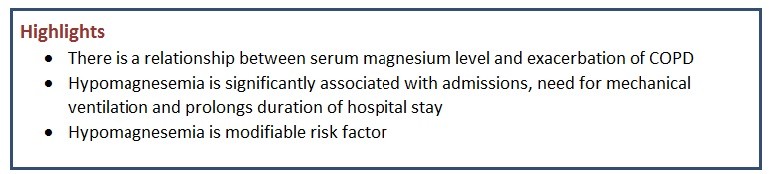
Our study demonstrated that patients with hypomagnesemia were more often admitted to the hospital, had more severe COPD, respiratory failure requiring ventilation. However, there were no associations with mortality or prolonged hospital stay the there was a trend for latter in hypomagnesemia patients.
Since magnesium is involved in muscle tone, therefore a decrease in magnesium in level in COPD patients represents a factor, which is detrimental to respiratory function as low magnesium level induces muscle fatigue (2, 3).
Out of all patients, 80 patients had a smoking history. Among all smokers, 39 patients had a history of smoking in the past and stopped smoking for at least the last six months while 33 patients were current smokers. Our study is similar to the survey conducted by Bhatt et al. (3), among acute COPD patients, where 90% of patients were either ex-smokers or current smokers.
Overall, 67.9% of our admitted patients had hypomagnesemia and 62.3% of them admitted patients required ventilation. Out of all patients with hypomagnesemia, 63.38% were admitted for more than 7 days similar to the study conducted by Makwana et al (3) and Gumus et al. (4) where duration of hospital stay for more than 7 days were more frequent in hypomagnesemia patients (4, 5). However, in our study, the differences were not significant, as hospital stay depends on many factors like comorbidities, medication usage and hypomagnesemia alone could not explain prolonged hospital stay duration in out cohort.
The overall mortality reported in the present study was 7%. The mortality rate was higher in the normomagnesemia group (26.7%) as there were more severe COPD patients in normomagnesemia group than in the hypomagnesemia group (8.3%), but the difference was not statistically significant (2, 3). It is also can be assumed that hypomagnesemia is a modifiable risk factor.
Hypomagnesemia, a condition characterized by abnormally low magnesium concentrations in the bloodstream, is a common finding among individuals undergoing an acute exacerbation of chronic obstructive pulmonary disease (COPD) (6-10). This electrolyte imbalance often reflects the complex physiological disturbances occurring during such exacerbations. Research has consistently highlighted a connection between magnesium levels and the length of hospital stay (4, 5).
Patients with reduced magnesium concentrations tend to experience extended periods of hospitalization, likely due to the vital role magnesium plays in numerous cellular and respiratory functions (11). Interestingly, despite its influence on hospital stay duration, hypomagnesemia does not appear to exert a direct effect on overall mortality rates among COPD patients.
This suggests that while magnesium levels are a valuable marker for monitoring disease severity and recovery trajectory, they may not independently predict patient survival outcomes.
Study limitations
Further extensive studies are necessary to clarify the role of magnesium in managing acute COPD exacerbations. This study included patients with pre-existing COPD, and the degree of obstruction at the time of study was not evaluated. Additionally, serum magnesium levels were not measured upon discharge and outpatient follow-up was not done. We did not report comorbidities.
Conclusion
Hypomagnesemia is a common finding in COPD patients who needs hospitalization. The low level of magnesium is related to the severity of COPD and respiratory failure requiring ventilation. Magnesium therefore can be a risk factor for COPD exacerbation and it is a modifiable risk factor. Hypomagnesemia is not associated with mortality.
Ethics: Institutional ethics committee approval was obtained and patient informed consent was taken for all procedures and study participation. Study is complied with the Declaration of Helsinki 2024 rules for human studies.
Peer-review: External and internal
Conflict of interest: None to declare
Authorship: C.V.R.C., V.N., R.G., A.R., and M.S. equally contributed to the study and manuscript preparation. All authors revised and approved final version, thus fulfilled authorship criteria.
Acknowledgements and Funding: None to declare.
Statement on A.I.-assisted technologies use: Authors used artificial intelligence (A.I.) tools for preparation of manuscript and authors carry full responsibility for the content.
Data and material availability: Contact authors, any sharing should in frame of fair use and collaboration with acknowledgement of source.
References
| 1.Global Initiative for Chronic Obstructive Lung Disease (GOLD). Global Strategy for the Diagnosis, Management, and Prevention of Chronic Obstructive Pulmonary Disease: 2024 Report. GOLD; 2024. | ||||
| 2.Kshirsagar K, Patil VC. Chronic obstructive pulmonary disease: Is serum magnesium level a risk factor for its acute exacerbation? Caspian J Intern Med 2021; 12: 223-7. doi:10.22088/cjim.12.2.223 | ||||
| 3. Bhatt SP, Khandelwal P, Nanda S, Stoltzfus JC, Fioravanti GT. Serum magnesium is an independent predictor of frequent readmissions due to acute exacerbation of chronic obstructive pulmonary disease. Respir Med 2008; 102: 999-1003. doi:10.1016/j.rmed.2008.02.010 https://doi.org/10.1016/j.rmed.2008.02.010 PMid:18396393 |
||||
| 4. Makwana S, Patel A, Sonagara M. Correlation between serum magnesium level and acute exacerbation in patients with chronic obstructive pulmonary disease (COPD). Cureus 2022; 14: e26229. doi:10.7759/cureus.26229 https://doi.org/10.7759/cureus.26229 |
||||
| 5. Gumus A, Haziroglu M, Gunes Y. Association of serum magnesium levels with frequency of acute exacerbations in chronic obstructive pulmonary disease: A prospective study. Biol Trace Elem Res 2014; 157: 95-100. doi:10.1007/s12011-013-9873-9 https://doi.org/10.1155/2014/329476 PMid:25485151 PMCid:PMC4251077 |
||||
| 6. Aziz EF, Javed F, Pratap B, Musat D, Nader A, Pulimi S, et al. Hypomagnesemia and hospital outcomes in patients with acute exacerbation of chronic obstructive pulmonary disease. Int J Clin Pract 2005; 59: 999-1003. | ||||
| 7.Shah BA, Naik MA, Rajab S, Muddasar S, Nabi G. Serum magnesium levels in exacerbation of COPD: A single-centre prospective study from Kashmir, India. J Med Sci 2010; 13: 15-9. https://doi.org/10.33883/jms.v13i1.38 |
||||
| 8.Singh JP, Kohli S, Devi A, Mahajan S. Serum magnesium level in COPD patients attending a tertiary hospital: a cross-sectional study. J K Sci 2012; 14: 197-200. | ||||
| 9.Kumar PN, Amirullah A, Kumar DR. Association between serum magnesium levels and acute exacerbations in chronic obstructive pulmonary disease patients. Int J Med Health Develop 2025; 30: 146-51. https://doi.org/10.4103/ijmh.ijmh_62_24 |
||||
| 10.Khan AM, Sheikh NS. Hypomagnesemia in acute exacerbation of COPD and clinical outcomes. J Pak Med Assoc 2018; 68: 877-81. | ||||
|
11.Rudolph AM. Role of magnesium in bronchial smooth muscle relaxation and airway function. Lancet 1995; 346: 447-8. |
||||
Copyright

This work is licensed under a Creative Commons Attribution-NonCommercial 4.0 International License.
AUTHOR'S CORNER