Answer to the letter to the Editor: Methodological and statistical considerations in the assessment of GH-IGF-1 axis dysfunction and linear growth in children with type 1 diabetes mellitus
LETTER TO THE EDITOR
Answer to the letter to the Editor: Methodological and statistical considerations in the assessment of GH-IGF-1 axis dysfunction and linear growth in children with type 1 diabetes mellitus
Article Summary
- DOI: 10.24969/hvt.2026.663
- CARDIOVASCULAR DISEASES
- Published: 08/07/2026
- Received: 07/07/2026
- Accepted: 07/07/2026
- Views: 17
- Downloads: 7
- Keywords: Children, type 1 diabetes mellitus, growth, growth hormone, insulin growth factor -1
Address for Correspondence: Feruzakhan Uvaidillaeva, Kyrgyz-Russian Slavic University named after B.N. Yeltsin, Bishkek, Kyrgyz Republic
Email: Feruzuvaidillaeva@gmail.com
ORCID: Feruzakhan Uvaidillaeva: 0000-0003-3657-0083 Facebook: feruza.uvaidillaeva
Answer to the Letter to the Editor
Answer to the letter to the Editor: Methodological and statistical considerations in the assessment of GH-IGF-1 axis dysfunction and linear growth in children with type 1 diabetes mellitus
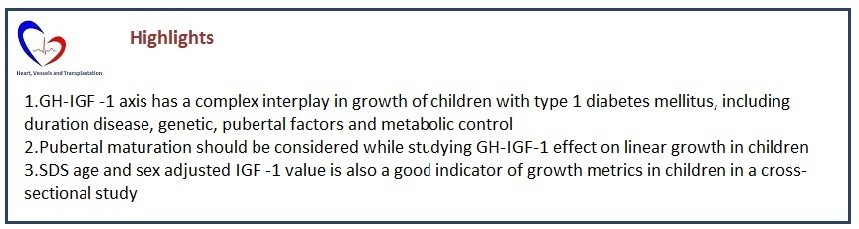
Key words: Children, type 1 diabetes mellitus, growth, growth hormone, insulin growth factor -1
Dear Editor,
We express our sincere gratitude to the author of the letter to the Editor - Umair Moin ud din for interest in our study, "Association between Disease Duration, GH-IGF-1 Axis Markers, and Linear Growth in Children with Type 1 Diabetes Mellitus," and for their appreciation of its significance for diabetology (1, 2). We also appreciate the constructive comment regarding the consideration of pubertal maturation, which is a crucial aspect when studying the growth hormone (GH)- insulin growth factor (IGF)-1 axis.
In response to the colleague's comments, we would like to clarify the following:
Use of SDS for standardization: In our study, anthropometric indicators (height, weight) and IGF-1 levels were presented as SDS (Standard Deviation Score). IGF-1 SDS values were calculated using regional normative data, taking into account the child's age and gender. Although Tanner staging is the "gold standard," the use of age- and sex-specific SDS in large cross-sectional studies is often the accepted method for standardizing growth metrics and hormonal levels, minimizing the influence of age differences in the 5- to 17-year-old group.
Duration of Disease as an Independent Factor: Despite the lack of direct adjustment for Tanner staging, our multivariate regression analysis revealed that disease duration was the strongest independent predictor of decreased SDS growth (ß = –0.338; p < 0.001). This supports our hypothesis that chronic metabolic impairment over many years has a more profound impact on physical development than current glycemic control (HbA1c). Limitations of the Study: We agree with the author that pubertal status may introduce additional variability. In the "Limitations of the Study" section, we noted that the cross-sectional design and the lack of longitudinal data on cumulative metabolic load limit the ability to establish direct causal relationships. We acknowledge that incorporating Tanner stages in future studies will allow for a more accurate differentiation of the impact of diabetes from physiological changes associated with puberty.
 Regarding genetic factors and residual confounding:
We fully agree with the statement that genetic potential (target height based on parental height) is a key determinant of a child's final height.
Study limitation: Unfortunately, the cross-sectional design of our study and the inpatient data collection setting did not allow for complete information on parental height for all 250 participants. This may indeed lead to residual confounding.
However, the use of the Standard Deviation Score (SDS) allows us to partially offset the influence of general population factors by comparing a child's height to the average values for their age and gender. We accept this observation as a valuable recommendation for our future studies, where taking into account genetic potential will be a priority for a more accurate assessment of the contribution of T1DM to growth retardation.
We believe that these clarifications do not change the main conclusion of the study: disease duration of more than 6 years is a critical factor associated with profound disruptions of the IGF-1 axis and delayed linear growth in children.
Sincerely,
Feruzakhan Uvaidillaeva
On behalf of authors
Kyrgyz-Russian Slavic University named after B.N. Yeltsin, Bishkek, Kyrgyz Republic
Peer-review: Internal
Conflict of interest: None to declare
Authorship: F.U.
Acknowledgements and funding: None to declare
Statement on A.I.-assisted technologies use: Artificial Intelligence tools were not during preparation of manuscript.
Data and material availability: Not available
References
| 1. Moin ud din U. Methodological and statistical considerations in the assessment of GH-IGF-1 axis ysfunction and linear growth in children with type 1 diabetes mellitus. Heart Vessels Transplant 2026: 10: doi:10.24969/hvt.2026.662 https://doi.org/10.24969/hvt.2026.662 |
||||
| 2. Uvaidillaeva F, Tuhvatshin R, Kniazeva V, Omurkulova B. Association between disease duration, GH-IGF-1 axis markers, and linear growth in children with type 1 diabetes mellitus: a cross-sectional study. Heart Vessels Transplant 2026; 10: doi:10.24969/hvt.2026.642 https://doi.org/10.24969/hvt.2026.642 |
||||
Copyright

This work is licensed under a Creative Commons Attribution-NonCommercial 4.0 International License.
AUTHOR'S CORNER