The milestones of cardiac anesthesiology and emergency medicine development in Kyrgyz Republic
HISTORICAL NOTE
The milestones of cardiac anesthesiology and emergency medicine development in Kyrgyz Republic
Article Summary
- DOI: 10.24969/hvt.2026.653
- CARDIOVASCULAR DISEASES
- Published: 25/05/2026
- Received: 19/05/2026
- Accepted: 20/05/2026
- Views: 441
- Downloads: 336
- Keywords: Cardiac anesthesiology, emergency medicine, historical note, Kyrgyzstan
Address for Correspondence: Aibek A. Ashyrbaev, Kyrgyz –Russian Slavic University named after B. N. Yeltsyn, Bishkek, Kyrgyz Republic
Email: aibeka@mail.ru
ORCID: Aibek A. Ashyrbaev - 0000-0001-9902-2346; Zhyldyzgul S. Derkembaeva - 0009-0001-2826-2243; Emirlan K. Kubanychbekov - 0009-0002-9717-2900; Zhyldyzbek A. Raimbekov - 0009-0001-4033-0886
Aibek A. Ashyrbaev1, Zhyldyzgul S. Derkembaeva2, Emirlan K. Kubanychbekov2, Zhyldyzbek A. Raimbekov2, Bishkek, Kyrgyz Republic
1Kyrgyz –Russian Slavic University named after B. N. Yeltsyn, Bishkek, Kyrgyz Republic
2I. K. Akhunbaev Kyrgyz State Medical Academy, Bishkek, Kyrgyz Republic
Abstract
In this article, the authors present data on the preconditions of development of anesthesiology and emergency medicine in Kyrgyz Republic. This article also follows up the history of this specialty's development in other republics of the former USSR. Between the mid-1960s and 1990s, a fully-fledged anesthesiology and emergency medical care service was established in Kyrgyz Republic. It became a vital part of the healthcare system, providing surgical capabilities, training of personnel, and developing a scientific and practical school. This article highlights the significant role of Academician Isa K. Akhunbaev, the organizer of the surgical service and the initiator of the development of anesthesiology and emergency medical care in the Kyrgyz Republic. Under his leadership, the first open-heart surgery using a heart-lung machine in Central Asia was performed on November 30, 1964. The role of Academician Mirsaid M. Mirrakhimov was particularly noted. Under his leadership, the first specialized emergency cardiology departments (coronary care units) for patients with acute coronary artery disease were established in the Kyrgyz Republic. Professor Mikhail G. Finger and Associate Professors Ashir Sh. Sharsheev and Alla A. Sherova made significant contributions to the development of this new specialty.
The materials for the study were data from the Kyrgyz State Medical Academy named after I. K. Akhunbaev, the Kyrgyz-Russian Slavic University named after B.N. Yeltsin, personal archives of doctors, as well as specialized literature on the topic of this work.
Key words: Cardiac anesthesiology, emergency medicine, historical note, Kyrgyzstan
Introduction
The history of cardiac anesthesiology and emergency medicine in Kyrgyz Republic spans over 60 years. This specialty emerged in the Kyrgyz Republic in the mid-1960s, and over time, it emerged as an independent branch of practical medicine. The development of this specialty in Kyrgyz Republic can be traced to its development in other republics of the former Soviet Union (1).
After the Great Patriotic War WWII, all medical specialties from various regions of the Union of the Soviet Socialist Republics (USSR) came to the Kirghiz Soviet Socialist Republic (Kirghiz SSR). The country’s leadership invited highly qualified medical specialists from other Soviet Republics, so the level of teaching at the Kirghiz State Medical Institute (I.K. Akhunbaev Kyrgyz State Medical Academy) was higher than the level of teaching in other medical institutes in the USSR (2).
The purpose of the study is to examine the prerequisites and historical development of cardiac anesthesiology and emergency medicine specialists in the Kyrgyz Republic.
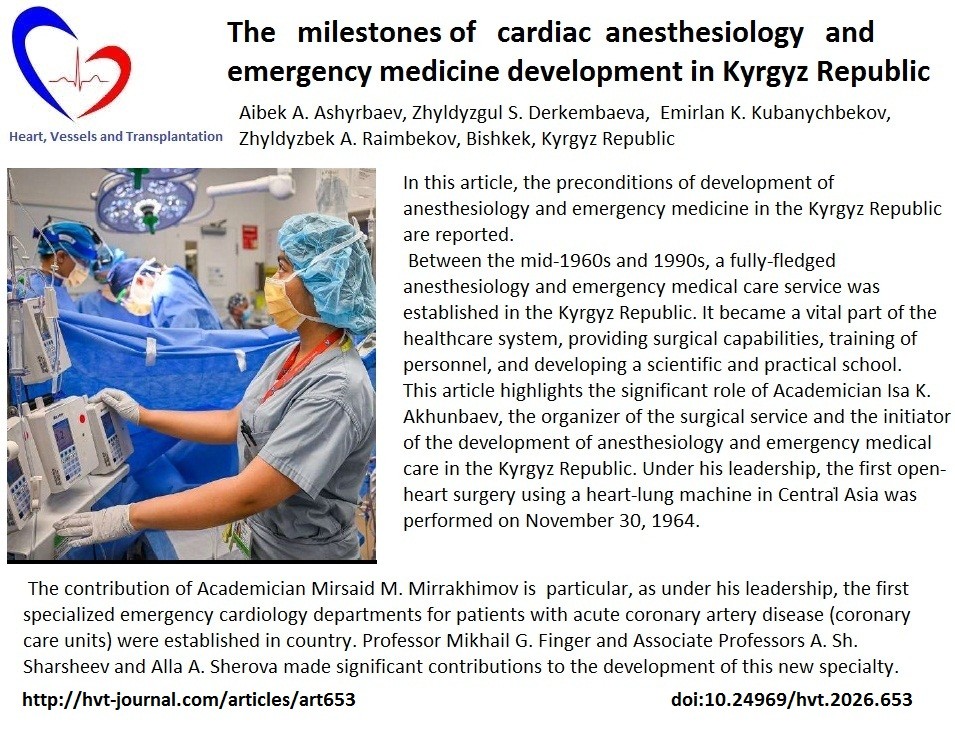
Graphical abstract
Methods
Articles related to the history of anesthesiology and emergency medicine in Kyrgyz Republic are very scarce. To conduct this study, the analysis of the articles related to this discipline was done.
The literature search was comprised of sources from electronic databases: Elibrary, Cyberleninka, Google scholar and websites of medical journals. In addition, the study utilized archival data from the I.K. Akhunbaev Kyrgyz State Medical Academy, the Kyrgyz-Russian Slavic University named after B. N. Yeltsin, the personal archives of Associate Professor Alla A. Sherova and specialized literature on this topic. The research methodology included chronological, biographical, and analytical methods.
Results
Prerequisites of the historical development of cardiac anesthesiology and emergency medicine and the establishment of a scientific and practical medical school in the Kirghiz SSR
The history of anesthesiology and emergency medicine in the Kirghiz SSR is closely linked to the development of the whole Soviet medicine. After the end of the Great Patriotic War (World War II), the advancement of surgery required further development of new areas of medicine such as anesthesiology, resuscitation, extracorporeal circulation, blood transfusion etc.
In the USSR, the conditions for establishing anesthesiology as an independent specialty emerged during the Great Patriotic War. During the war on the battlefields, the experience of combat surgeons demonstrated the need for a new type of specialists in medicine. In 1947, the Academician P. A. Kupriyanov, the head of the surgical clinic of the Military Medical Academy in Leningrad (Now Military Medical Academy named after S. M. Kirov), sent their doctor M. N. Anichkov on a mission abroad to study anesthesiology.
In 1954, an anesthesiology department was organized in his clinic and training of anesthesiologists for the Soviet Army has begun. In 1956, a new doctor-anesthesiologist was appointed at the Main Military Clinical Hospital (Now Main Military Clinical Hospital named after N. N. Burdenko), and in 1957 at the Central Military Clinical Hospital named after P. V. Mandryka (3).
The XXVI th Congress of Surgeons of the USSR in 1955 emphasized the need to form anesthesiology as an independent clinical discipline. A significant step forward in anesthesiology was the USSR Ministry of Health (MOH) Order №537 in 19.12.1959 "On Approval of the Regulations on Anesthesiologists". The Order noted that anesthesiology became an independent branch of medicine. However, this Order did not comprise the regulations. The work of doctor-anesthesiologists was stipulated mainly by “Job Descriptions”. In 1960, the USSR MOH issued Order №169: "On Staffing Standards for Hospital Medical Personnel Specializing in Anesthesiology", which outlined functions and working standards.
The next USSR MOH Order №287 on 14.04.1966: "The Measures for the Further Development of Anesthesiology and Resuscitation in the USSR" was an important step in the training of medical doctors in the new specialty. This order developed regulations for the anesthesiology departments and introduced working standards for doctors and nurses. Anesthesiology and Resuscitation (AR) departments were organized in most medical institutions in the USSR. Thus, a new clinical discipline defined goals, objectives, functions, workload, and obligations of new medical specialists (4, 5).
In the Kirghiz SSR, after the MOH Order №287, the first Anesthesiology and Reanimation (AR) department was organized at the Republican Clinical Hospital (Now National Hospital of the Ministry of Health of the Kyrgyz Republic) of the MOH of the Kirghiz SSR in 1966. The hospital purchased new medical equipment and arranged premises for doctors and nurses. This had a great influence on improving the working conditions of the medical personnel (6).
The “AR groups” were reorganized into AR departments in accordance with the USSR MOH Order №605 in 19.08.1969: "On improving the anesthesiology and resuscitation service in the country." The order approved the "Regulations of the anesthesiology and resuscitation department of the medical institution" and "Temporary staffing standards for medical personnel of anesthesiology and resuscitation departments or groups".
The work of a doctor-anesthesiologist was comprised of provision of anesthesia during and after surgical operations, monitoring and support of vital functions after surgery, traumas, poisoning and other emergency situations. The program also included the training of anesthesia nurses.
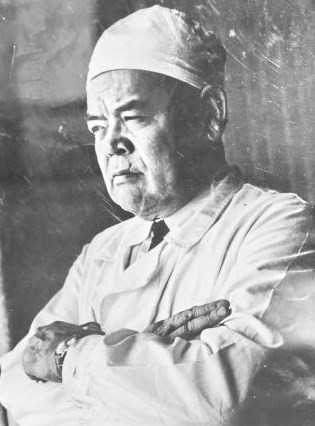
In the Kirghiz SSR, the formation of the new medical specialty has been connected with Academician I. K. Akhunbaev. On his initiative, the first group of anesthesiologists was organized in the department of thoracic surgery at the Republican Clinical Hospital in the capital Frunze (Now the capital Bishkek of the Kyrgyz Republic) of the Kirghiz SSR. Since then, a new specialty has emerged in the country. Figure 1 shows Academician Isa K. Akhunbaev.
|
|
|
|
|
|
Figure 1. Academician Isa K. Akhunbaev |
|
In the Kirghiz SSR, the first anesthesiology groups began to form in the early 1960s. Three clinical bases were organized where physicians and nurses could obtain training in anesthesiology and emergency medicine: the clinic of the general surgery of the Republican Clinical Hospital, the Oncology Institute, and the Tuberculosis Institute.
In 1963, the Chief Physician of the Republican Clinical Hospital S. D. Rafibekov organized the first department of anesthesiology. Dr. Mikhail S. Finger became the head of the department. Doctors V. M. Ezhov, R. S. Shukurova, R. T. Kosachevskaya, A. A. Sherova, A. I. Shevchuk became first anesthesiologists.
Doctor Mikhail Grigorievich Finger was born in 1930 in Ukraine. During the Great Patriotic War (World War II) he was evacuated to the Kirghiz SSR. In 1952, M. G. Finger graduated from the Kirghiz State Medical Institute and began to work as a surgeon in rural hospital. In 1958, he began to work as a surgeon at the Republican Clinical Hospital. Professor Isa K. Akhunbaev identified him as a talented and promising doctor, so he sent him to the Institute of Thoracic Surgery (Now: National Medical Research Center of the Cardiovascular Surgery named after A. N. Bakulev) in Moscow to obtain training in anesthesiology (7, 8).
In the 1960s, the cardiac surgery under general anesthesia with mechanical ventilation of lungs began to develop rapidly in the USSR. There were several leading cardiac surgery centers in the country, employing innovative methods during heart surgery: Moscow, Kiev, Leningrad, Novosibirsk (9, 10).
Under the leadership of Academician Isa K. Akhunbaev the first cardiac surgery among all Central Asian republics for the patient with an atrial septal defect with use of extracorporeal circulation was performed at the surgical clinic of the Republican Clinical Hospital on November 30, 1964. Joint team of doctors from the Institute of Thoracic Surgery of the USSR Academy of Medical Sciences and doctors from the Republican Clinical Hospital took part in the operation. The operating brigade consisted of cardiac surgeons: professors I. K. Akhunbaev and V. A. Bukharin; anesthesiologists - M. G. Finger, R. T. Kosachevskaya, L. Terentyeva; perfusiologist - A. A. Sherova, A. A. Pisarevsky, N. M. Mukhamedziev; laboratory physician - M. E. Radzivilovskaya; surgical nurses - N. E. Pogozheva and T. I. Bezryadina; anesthesia nurse - V. Khegay (11).
The next USSR MOH Order №1188 on 29.12.1975, "On the further improvement of resuscitation care for the population," determined the formation of intensive care departments in large multidisciplinary hospitals. In 1976, a new anesthesiology and emergency medicine department commenced at the Republican Clinical Hospital. This department became the central medical teaching organization for doctors and nurses for the whole country.
New intensive care methods and emergency medicine protocols were elaborated. The Republican Clinical Hospital purchased two hyperbaric chambers and equipment for detoxification treatment. Methods of regional anesthesia, hyperbaric oxygenation, and other emergency medicine techniques were mastered (12).
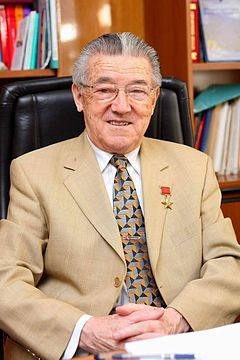
The USSR MOH Order №890 on 13.11.1973 “On improving medical care for patients with myocardial infarction” expedited the foundation of first specialized intensive coronary care units (Department of Urgent Cardiology of the National Center of Cardiology and Therapy named after M. M. Mirrhakhimov in the Kirghiz SSR). Great contribution in this matter belongs to the Academician Mirsaid M. Mirrakhimov, the director of the Kyrgyz Scientific Research Institute of Cardiology (National Center of Cardiology and Therapy named after M. M. Mirrhakhimov). Figure 2 shows Academician M. M. Mirrakhimov.
|
|
|
|
|
|
Figure2. Academician Mirsaid. M. Mirrhakhimov |
|
Formation and development of the medical school of anesthesiology, resuscitation and emergency medicine
After the XXVI th Congress of Surgeons of the USSR, first docent (associate professor)-courses and departments of anesthesiology were established in many institutions. In 1958, the first AR department was founded at the Military Medical Academy named after S.M. Kirov in Leningrad.
Since early 1960s, the first AR docent-courses and department were organized in capitals of all Soviet Republics. Scholars such as Y. N. Shanin, E. A. Damir, V. L. Vanevsky, and others made significant contributions to academic programs.
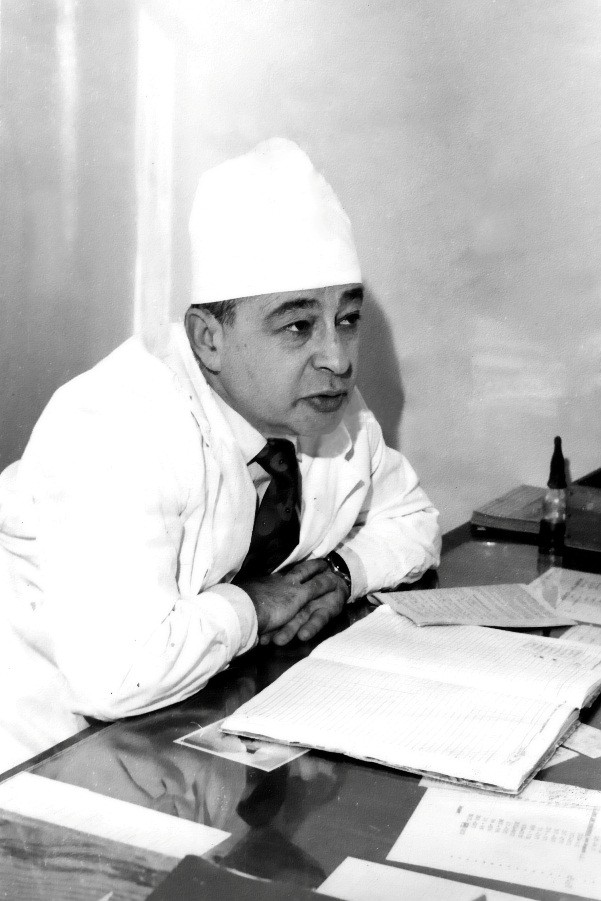
Dr. Mikhail G. Finger organized the first course of anesthesiology in the Kirghiz SSR. In 1976, Doctor M. G. Finger was appointed as the head of the docent-course. In 1987, he became the first head of the new anesthesiology department at the Kyrgyz State Medical Institute (KSMI). In 1989, doctor M. G. Finger became the first professor of anesthesiology in the Kirghiz SSR (13). Figure 3 shows professor M. G. Finger.
|
|
|
|
|
|
Figure 3. Professor Mikhail G. Finger
|
|
Professor M. G. Finger dedicated 33 years of his life to the anesthesiology and emergency medicine. For 15 years he directed the anesthesiology course and the department. Professor M. G. Finger retired in 1991. After him, Associate Professor Ashir S. Sharsheev became head of the anesthesiology department at the KSMI. Associate Professor Alla A. Sherova became the head of the docent -course at the Republican Center for Continuous Training of Medical Workers (Now Kyrgyz State Medical Institute of Retraining and Advanced Qualification named after S. B. Daniyarov).
Nowadays, besides Kyrgyz State Medical Academy, training of emergency medical specialists has been conducted at the Emergency Medicine training centers at the Kyrgyz State Medical Institute for Retraining and Advanced Qualification in Bishkek and Osh. These centers were organized with the support of international organizations (14).
Today, doctors in Kyrgyzstan continue to engage in daily scientific and practical work. They have published research articles and actively participate in various scientific conferences locally and overseas. Nowadays, thanks to the legacy of professor M. G. Finger high professionalism of medical specialists in anesthesiology and emergency medicine in Kyrgyzstan, all types of surgical operations and emergency medicine treatment are provided at high level.
Conclusion
1. The formation and development of anesthesiology-resuscitation and emergency medicine as a new specialty in the Kyrgyz Republic specialty has been connected with the names of Academicians I. K. Akhunbaev and M. M. Mirrakhimov, professor M. G. Finger, Associate Professors A. S. Sharsheev and A. A. Sherova.
2. The first cardiac surgery among all Central Asian republics was performed at the National Hospital of the MOH of the Kyrgyz Republic on November 30, 1964.
3. The National Hospital of the Ministry of Health of the Kyrgyz Republic and Kyrgyz State Medical Academy played a key role in the preparation of the specialists in anesthesiology and emergency medicine.
Peer-review: Internal
Conflict of interest: None to declare
Authorship: A.A.A., Zh.S.D., E.K.K., and Zh.A.R. equally contributed to manuscript preparation and approved final version for publication, thus fulfilled all authorship criteria
Acknowledgements and Funding: None to declare.
Statement on A.I.-assisted technologies use: Authors stated they did not use artificial intelligence (A.I.) tools for preparation of the manuscript
Data and material availability: Do not apply
References
| 1. Malyshev YuP, Redko AN, Romantsov VV.History of the formation and development of the Krasnodar scientific medical school of anesthesiology and reanimatology. Ann Crit Care 2024; 4: 173- 83. DOI: 10.21320/1818-474X-2024-4-173-183 https://doi.org/10.21320/1818-474X-2024-4-173-183 |
||||
| 2. Fridman AL. My friend said. Centr Asian Med J 1997; 3:156- 60. | ||||
| 3. Polushin YuS. Handbook of Anesthesiology and Resuscitation. St. Petersburg. 2004: 31-3. | ||||
| 4. Netesin ES, Gorbachev VI. The history of establishment of the service of anesthesiology and intensive care in the Russian Federation in the orders. Healthcare Man 2015; 9 :44-54. | ||||
| 5. Yamshchikov ON, Makedonskaya IV, Kopylov DM, Yamshchikova SO, Marchenko NA. History of the formation and development of the specialty of anesthesiology-resuscitation: key stages and personalities. Avicenna Bull 2025; 27: 1045-55. (In Russ). https://doi.org/10.25005/2074-0581-2025-27-4-1045-1055 |
||||
| 6. Sherova AA. On the Development of Anesthesiology and Resuscitation in Kyrgyzstan. Bishkek. 2008. pp. 173-182. | ||||
| 7. Ismailova UA, Logacheva EG. The role of Academician I.K. Akhunbaev in the formation and development of the anesthesiology and resuscitation service of Kyrgyzstan. Healthcare Kyrgyzstan 2008; 1: 10-13. | ||||
| 8. Boshkoev ZhB, Sherova AA, Ismailova UA, Khantimerov RM, Seitalieva ZK. History of the formation and development of the Department of Anesthesiology and Resuscitation with a burn trauma course of the Kyrgyz State Medical Academy. Bull KSMA named after I. K. Akhunbaev 2009; 1: 16-8. | ||||
| 9. Lomivorotov VV, Efremov SM, Kirov MY, Guvakov DV, Kozlov IA, Lomivorotov VN, et al. History and current status of cardiac anesthesiology in Russia. J Cardiothorac Vasc Anesth 2019; 33: 3358-65. DOI: 10.1053/j.jvca.2018.06.015 https://doi.org/10.1053/j.jvca.2018.06.015 PMid:30072269 |
||||
| 10. Guvakov D, Bezinover D, Lomivorotov VV, Postnov VG, Weiss SJ, Cheung AT, et al. The "Ice Age" in cardiac surgery: Evolution of the "Siberian" method of brain protection during deep hypothermic perfusionless circulatory arrest. J Cardiothorac Vasc Anesth 2019; 33: 3366-74. DOI: 10.1053/j.jvca.2019.04.001 https://doi.org/10.1053/j.jvca.2019.04.001 PMid:31129071 |
||||
| 11. Sherova AA., Zhooshev KT, Usupbaeva GT. Cardiac anesthesiology of Kyrgyzstan. Surg Kyrgyzstan 2008; 1: 8-13. | ||||
| 12. Association of Anesthesiologists and Resuscitators of Kyrgyzstan. Memory: Ashir Sharsheevich Sharsheev. Bull | ||||
| KSMA named after I. K. Akhunbaev 2015; 2: 69-171. | ||||
| 13. Sherova AA, Moldotashova AK, Derkembaeva ZhS, Tolbashieva GU. Development of science and practice in pain relief and intensive care in Kyrgyzstan over 60 years. Med Kyrgyzstan 2022; 3: 59-76. | ||||
| 14. Ashyrbaev AA. Current trends of preparation of medical specialists at the remote industrial facilities in the Kyrgyz Republic: (narrative review). Heart Vessels Transplan 2026; 10: XXX-XX. doi: 10.24969/hvt.2026.627 https://doi.org/10.24969/hvt.2026.627 |
||||
Copyright

This work is licensed under a Creative Commons Attribution-NonCommercial 4.0 International License.
AUTHOR'S CORNER